Unit 18 ASSESSMENTS TYPES AND TASKS

Assessment is judging learners’
performance by collecting data. We can assess formally and informally. Formal assessment is
when we assess our pupils through tests or exams, giving them a grade whereas informal assessment
is observing how well our learners are doing something, giving comments about
their performance. We can use distinctive types of formal tests such as diagnostic (to measure
what students know and do not know, it helps you to decide what to teach), placement test (to
decide what level of class your learners should go into), progress test (to see
how well learners have learnt what it was covered during a unit, it helps you
to decide if you need to give feedback on your pupils strengths an difficulties
in this area), achievement
test or summative test (to see how well your pupils have learnt the contents
of the whole course, it is given at the end of the course) or proficiency test (to
measure your learners’ general skills or abilities in the language). In formal
assessment, I would use multiple-choice questions, gap-fill, reading for
specific information; you choose the type of question depending on what you are
going to evaluate. Moreover, assessment tasks are often described as objective and subjective, in the first
you do not have to judge whether the answer is correct or wrong because there
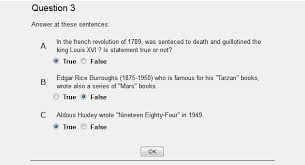
is only one answer correct (e.g. you can use true/false questions, matching tasks or multiple-choice).
On the other hand, in subjective tasks you need to judge your pupils’ answer and
decide if it is wright or wrong. Here, I would evaluate my pupils by asking
them to do interviews, role-plays, essays, etc. We can also use informal assessment in our
classroom, it is used to find out more about our learners level, attitudes and
learner characteristics. To assess informally, I would ask my pupils to do groups works to
judge their level of fluency or to see how motivated they are. Informal
assessment is usually used with young learners, pupils can also assess
themselves (self-assessment)
or they can be assessed by their classmates (peer assessment). You can assess fluency, use
of language, pronunciations, vocabulary, etc. when assessing informally. In
conclusion, you must use an appropriate type of assessment (formal or informal)
depending on what you want to measure. You
cannot use only the tests that your school gives you since you have to decide
if you need a subjective or objective task. Your work is not only using the
tests provided by the school, you have to look forward and seek the appropriate
test, assessment or task to evaluate or measure your students’ knowledge about
the language.
These pictures show some
possible tasks, or type of questions you can use to assess yout pupils.
Formal Assessment
Objective tasks (true/false and matching questions)

Subjective tasks (interviews and essays)


Informal Assessment (peer assessment and self assessment)


References for additional
information
- Types of assessment. (2014) (1st ed., pp. 1 to 12). Retrieved from http://www.rand.org/content/dam/rand/pubs/monograph_reports/MR836/MR836.ch3.pdf
- App.griffith.edu.au,.
(2014). Assessment Matters. Retrieved 6 December 2014, from http://app.griffith.edu.au/assessment-matters/docs/assessment-methods/tasks.
- Uts.edu.au,. (2014). Types
of assessment | University of Technology, Sydney. Retrieved 6 December
2014, from
http://www.uts.edu.au/research-and-teaching/teaching-and-learning/assessment/types-assessment
